Which Door Style Should A Bespoke Walk In Closet Have At Its Entrance?
The door is the first thing you touch and the frame through which the whole room is seen. Here is how to choose between hinged, pocket, sliding, and no door at all, and what each means for the room behind it.
What the entrance has to do
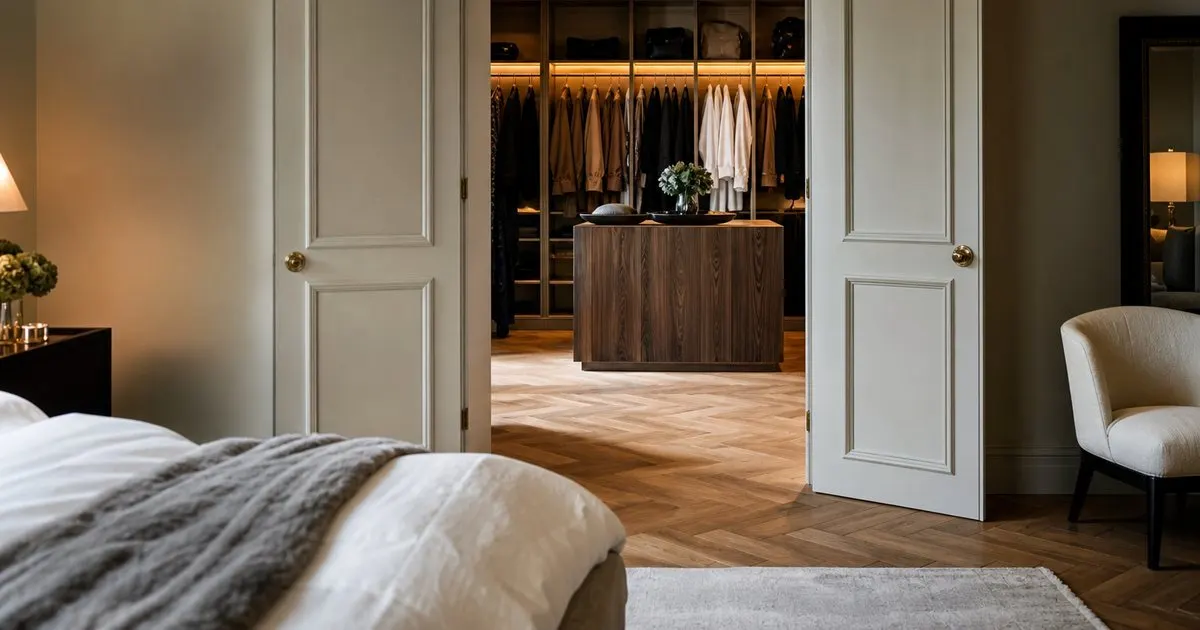
The closet door does more work than most doors in a house. It has to open cleanly without blocking the aisle or a wardrobe door, close quietly so one person can dress while another sleeps, hold back humidity and light from the bedroom, and present the room well when open. It is also the transition from the bedroom's design language to the closet's, and in a bespoke project the two are often deliberately different: a soft, upholstered bedroom giving way to a tailored, cabinet-like dressing room. Related: How Much Does A Truly Bespoke Walk In Closet Cost To Build?
Start with the practical constraints. Where does the door swing, and what does it hit? Is there wall thickness for a pocket? Does the closet share a wall with a bathroom, in which case a solid, gasketed door is worth its weight? Is the opening wide enough for a double door, which changes the sense of arrival entirely? And how much of the closet do you want visible from the bed? Those five questions narrow the field before style enters the conversation.
Keep reading: How Much Does A Truly Bespoke Walk In Closet Cost To Build?, What Distinguishes A Custom Dressing Room From An Ordinary Built In Wardrobe?, How Do You Plan Lighting And Ventilation For A Luxury Walk In Closet?. See how Wardrobr helps you a designer guide to bespoke walk-in closets and dressing rooms.
Hinged doors: the classic, with conditions
A hinged door is the quietest, best-sealing, and most solid-feeling option, and in a bespoke room it can be a genuine piece of joinery: full height, paneled or flush, with concealed hinges and a substantial lever. A pair of doors at the entrance to a large dressing room is one of the most gracious gestures in residential design and reads as a room within a room rather than a closet. Hinged doors also allow a mirror on the inside face, which puts a full-length view exactly where you would otherwise waste a wall. Related: What Distinguishes A Custom Dressing Room From An Ordinary Built In Wardrobe?
The condition is swing. A door that opens into the closet eats aisle and often conflicts with the first wardrobe door or drawer; a door that opens into the bedroom needs clear floor there and can feel intrusive. Designers usually favor swinging into the closet with the first section of millwork set back to accept it, or specify a full-height door with a stop that holds it flat against a plain wall. Ask for a soft-close or a well-adjusted closer and a floor-mounted stop rather than a wall bumper, which marks the door over time.
Pocket and sliding doors: space saved, trade-offs accepted
A pocket door disappears into the wall and gives back the swing space entirely, which is why it is the default in compact plans and in closets that open off a bathroom corridor. Modern pocket hardware with soft-close and heavy-duty tracks has removed most of the old complaints about rattle and drift, but not all: a pocket door seals less tightly than a hinged one, it cannot carry a mirror on the inside without complication, and the pocket itself consumes a wall you might have used for shallow shelving.
Surface-mounted sliding doors, whether a rustic rail or a more refined top-hung panel, save swing without needing a pocket, and a large, well-detailed panel in wood or glass can be a striking object. Their weaknesses are the gap at the edges (light, sound, and humidity all pass), the wall they must slide across, and the hardware, which must be exceptionally quiet to belong in a bedroom. Where a slider is chosen, ask for a floor guide, a soft stop at both ends, and a track rated well above the door's actual weight.
Glass, no door, and the question of privacy
Glass doors, whether clear, reeded, or lightly tinted, turn the dressing room into a lit display seen from the bedroom, and paired with interior lighting on a scene they can be beautiful at night. They demand a room that is always tidy and a client who wants to see their wardrobe, and they carry light and some sound. Reeded or fluted glass is the usual compromise, giving glow without detail. Frame materials range from painted timber to slender metal, and both must be stiff enough that the door does not flex on its hinges. Related: How Do You Plan Lighting And Ventilation For A Luxury Walk In Closet?
The doorless opening, a cased archway or a wide portal, works in suites where the closet is a room in a sequence between bedroom and bath rather than a space to be closed. It gives the most generous sense of arrival and no hardware to fail, but it offers no control of light, sound, or humidity, and it means the closet must be finished to the same standard as the bedroom it is now part of. Many of the finest dressing rooms are entered this way; many more are entered through a heavy pair of doors precisely because their owners wanted a threshold to cross. Choose the version that matches how you actually live. Related: Which Materials And Hardware Signal Real Quality In A Bespoke Dressing Room?
- Answer five constraints first: swing conflicts, pocket depth, an adjacent bathroom, opening width, and how much of the closet you want seen.
- A hinged door seals and sounds best and can carry a mirror; solve its swing with a set-back first section or a flat stop.
- Pocket doors give back swing space but seal less, and sliders need very quiet hardware and a wall to slide across.
- Glass or no door at all is a choice about display and privacy, and both demand a room finished to bedroom standard.

Julien Jimenez
Julien Jimenez is an independent software builder based in Paris. He designs, ships, and operates focused SaaS products for small businesses and independent professionals. Read the full author page.
A Dressing Room Made for You
A designer guide to bespoke walk-in closets and dressing rooms. Wardrobr is built to help you put this into practice.
Design your closetMore from the Wardrobr blog
How Much Does A Truly Bespoke Walk In Closet Cost To Build?
What Distinguishes A Custom Dressing Room From An Ordinary Built In Wardrobe?

How Do You Plan Lighting And Ventilation For A Luxury Walk In Closet?
Get the complete bespoke walk-in closets and dressing rooms guide
Our full buying guide, the price guide, and new research as we publish it. One email, no spam, unsubscribe any time.